

Making Irpinia, home
You can't have the Amalfi Coast without the Campania behind it

Also available on Hudin.com to Personal & Commercial subscribers.
If one searches for the highlights to visit in Campania, Italy, you’ll note a running similarity: they’re essentially all on the coast. Naples, Sorrento, and Pompeii are cities and sites which always pop up and are definitely worth a visit. I’d even posit that Naples, either in spite of or due to its innate chaos, is one of the few places in Italy that I still truly love.
Continuing down one’s listicle of choice will arrive to Vesuvius and the islands of Ischia and Capri for natural wonders that one ‘must’ visit. And of course, there’s always Positano and the Amalfi Coast…
After seeing endless glam shots on The Socials, I finally visited this region. While very pretty from above, once you’re done jostling for a view amongst the influencer set and you actually enter the villages, everything is overpriced and without a level of quality to match. Crowded amongst all these shops with white clothing with blue patterns, are tourists crammed shoulder to shoulder, complaining about how everything is overpriced. Needless to say, a brief stop in Sorrento, while still holding its fair share of tourists, was far more pleasant.
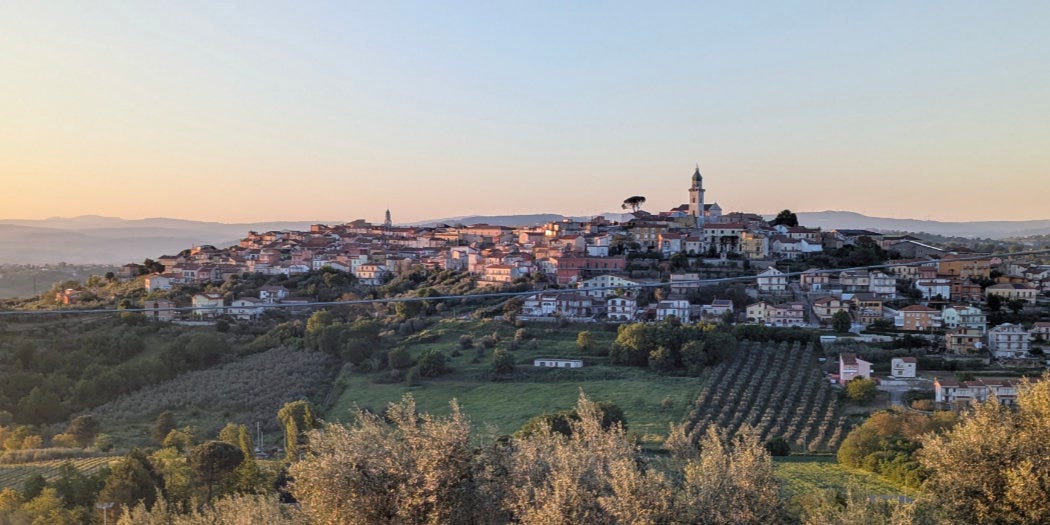
Once you peel back the all that lemon-themed pith from the coast, few lists will talk about much else. This is truly a pity as there’s very little in Italy that isn’t nice and the interior region of Campania is often overlooked for some reason. I don’t understand how as it checks off any Italy visit list with rolling hills, old villages, and most importantly, wine, especially in the province of Avellino, also known as Irpinia.
I hadn’t managed to visit Campania until last fall and it wasn’t the best of visits given that it was absolutely horrid weather and very, very cold. Despite this I did get in contact with Milena Pepe of Tenuta Cavalier Pepe to arrange another visit in the spring under what I could only hope were better meteorological conditions.
A country of wine born anew
At the core of the winery is an estate, named after Angelo Pepe, who had inherited it from his parents and grandparents. While originally from the region, Angelo had moved to Brussels and opened several restaurants, eventually meeting a Belgian woman which in turn saw the arrival of their daughter, Milena.
He started planting new vines on the family lands in the 1990s and built the initial phase of the winery. After being awarded the Knight of the Republic (Cavaliere della Repubblica) in 1998, Angelo set about fully bringing the project to fruition with Milena who had studied viticulture and oenology. Ultimately, they saw their first vintage arrive in 2005.
I never got the chance to meet Angelo as he unfortunately died in 2024, but upon meeting Milena, it was clear to see that the winery wouldn’t have continued without her.
Despite being half Southern Italian, you don’t see it outwardly in any sense, nor do you hear it as, having grown up initially in Brussels, she has a French accent in both English as well as Italian. But when it comes to her approach to people, the Italian in her shines though as while she’s been the one in charge of the winery (with even more responsibility for the last two years) there is an immediate welcoming quality to her.
I haven’t any idea how it must have been in first years as starting up a winery isn’t easy, especially as a young woman in Southern Italy. She even mentioned while I was touring the winery with her that she fell from a cement tank during harvest and was injured, needing to go to the hospital in secret, but then “walking it off” otherwise as she didn’t want anyone to see her as weak, including her family.
Today, I doubt anyone would see her for anything except the person in charge of the winery. Her team runs in a fine manner, despite the fact she’s often speaking to a number of them in French, despite their being Italian, and they’ve all been with the winery for a long time.
A green land all the year
The winery sits in the middle of Taurasi country, the first wine region in Southern Italy to receive a DOCG. For those in wine circles, you’ll know that its core grape is Aglianico which those even deeper into wine will joke about “next year being the year of Aglianico”. It’s a well-structured, high-quality red grape but it often needs many years of aging to reach its full potential to make wonderful wines.
Given that I’ve had a number of wines from Taurasi over the years, I was rather surprised to find that there isn’t all that much produced. There were only about 840,000 bottles in the 2020 harvest (recent numbers are very hard to come by) and so most wineries produce a broad range of wines to fill out their portfolio and general offer.
Cavalier Pepe is no exception to this as they produce a true Campanian rainbow, including reds (with a strong emphasis on Taurasi), whites, a rosé, and even several sparkling wines. Something rather novel is that Milena has clearly seen that the “chilled red” segment gaining momentum and created ‘Rossochiaro’ that’s a blend of Aglianico, Merlot, and Sangiovese meant to be served at 10˚C/50˚F and is released under the more lenient Irpinia IGT.
This is another key aspect to Milena in that she’s not afraid of change. The region never suffers from water and is green all year round so Climate Change hasn’t taken its toll as it has in most of the Southern Mediterranean. They are however not immune to market changes. One of the biggest shocks during her two decades at the winery was the pandemic which closed all hospitality and in turn, her biggest sales channel, given that they sell a tremendous amount to the coastal areas of Campania where all the tourists go.
She saw this as a moment to boost the visits to the winery and in the two days I was there, I saw a tremendous amount of movement which, while not huge crowds, was significant as it meant people making the trip in from the coast about an hour away.
And this, in addition to producing exemplary wines from the region, is what will see long term success for the winery. Being so far away from the main gravity of tourism for the region, they need to be a destination in and of themselves. Being open for wine tastings is one thing, but having a holistic, far-reaching offer is another.
This is one of the big problems of Irpinia’s development as a tourism destination in that it’s a chicken and egg situation. The offer of hotels and restaurants is simply nowhere near what it is on the coast, because there isn’t the level of visitors. But there isn’t more development, because there aren’t the visitors. The upside to this is that what there is, is very authentic currently for those willing to make a day trip from Napoli, Sorrento, or Salerno.
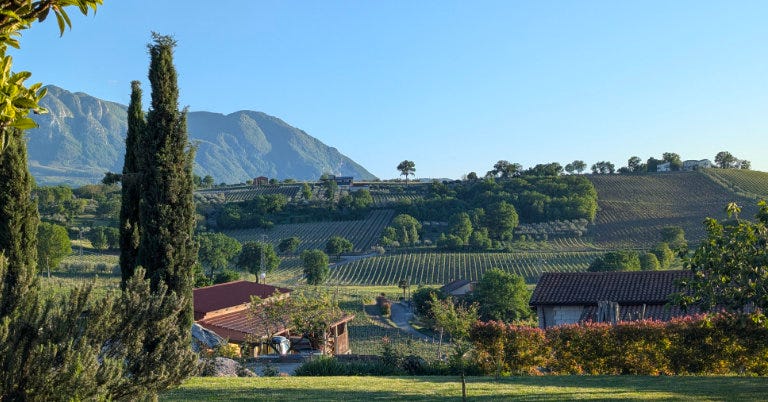
In addition to the winery, they also have L’Antica Fattoria, two comfortable apartments to stay at very close to the winery, with a stunning morning view out over the vines.
Wine doesn’t exist in a vacuum
But above and beyond that, there’s their restaurant, La Veduta which re-opened under their direct management in 2019. It means, “the view” in Italian and yes, it most definitely lives up to every part of the name, especially going to eat there at sunset. The food is tremendously good and well-prepared. Just be careful to pace yourself as, being used to “small plates” that exist most everywhere today, I ordered far too many things my first night.
But beyond the excellent food, view, and service is the fact that they’re serving their wines and because they have such a broad range of styles, it all pairs very, very well. To say that you can “make a day of it” by visiting the winery and eating at the restaurant isn’t an exaggeration and if you are lucky enough to have Milena take you around, she’s able to explain how the process of winemaking works in a manner that makes you feel like you’re learning about it with her. I’m not sure how she manages to do it in such a warm, inviting manner as she’s probably done it hundreds of times previously, but many in wine education could learn from her un-lecturing style.
For those looking to branch out from Cavalier Pepe, I’d also recommend Fontana Madonna, run by Milena’s cousin who specializes in local dishes as well as ‘chili-culture’ which is exactly what the name implies. There’s also Ristorante Cocò run by another of Milena’s cousins (the family clearly has a knack for running restaurants) and made what was one of the best pizzas I’ve had in I don’t know how long.
I won’t lie, the region is more sparsely populated than what people who have been to Piemonte or Toscana may be accustomed to, but the hills and rolling valleys are wonderful to drive around and there are countless places that make for a nice stop such as Castello di Gesualdo. I only had two days to meander around, but I’m sure there are countless more as this is a region that’s been inhabited since before Roman times.
A new home in an old place
Milena has called this region home for nearly half her life now and is firmly established having married a local Italian and brought her two sons up there, who in meeting them briefly, carry their mother’s openness and I’m sure will one day fit right into the winery if they desire.
Despite arriving as an outsider, she’s become firmly involved in the inner workings of the region, even serving as the president of the Consorzio Tutela Vini d’Irpinia from 2013 to 2017.
Her wines are constantly developing and she’s one of the leading forces in striving to make Aglianico viewed as serious, international grape, even if Taurasi may not be on the tip of winedrinker’s tongues, yet. Next year?
Above all, it’s the holistic sense of creating a destination, not fearing change, and adapting and reacting to the changes in the wine world which will see Cavalier Pepe succeed under her direction.
I look forward to visiting again someday in the future and enjoying this relatively still-hidden corner of Campania as it develops into more of a destination for those who know how to live and enjoy the hosting of people such as Milena Pepe.
Following are a few recommendations from the extensive list of wines they produce.